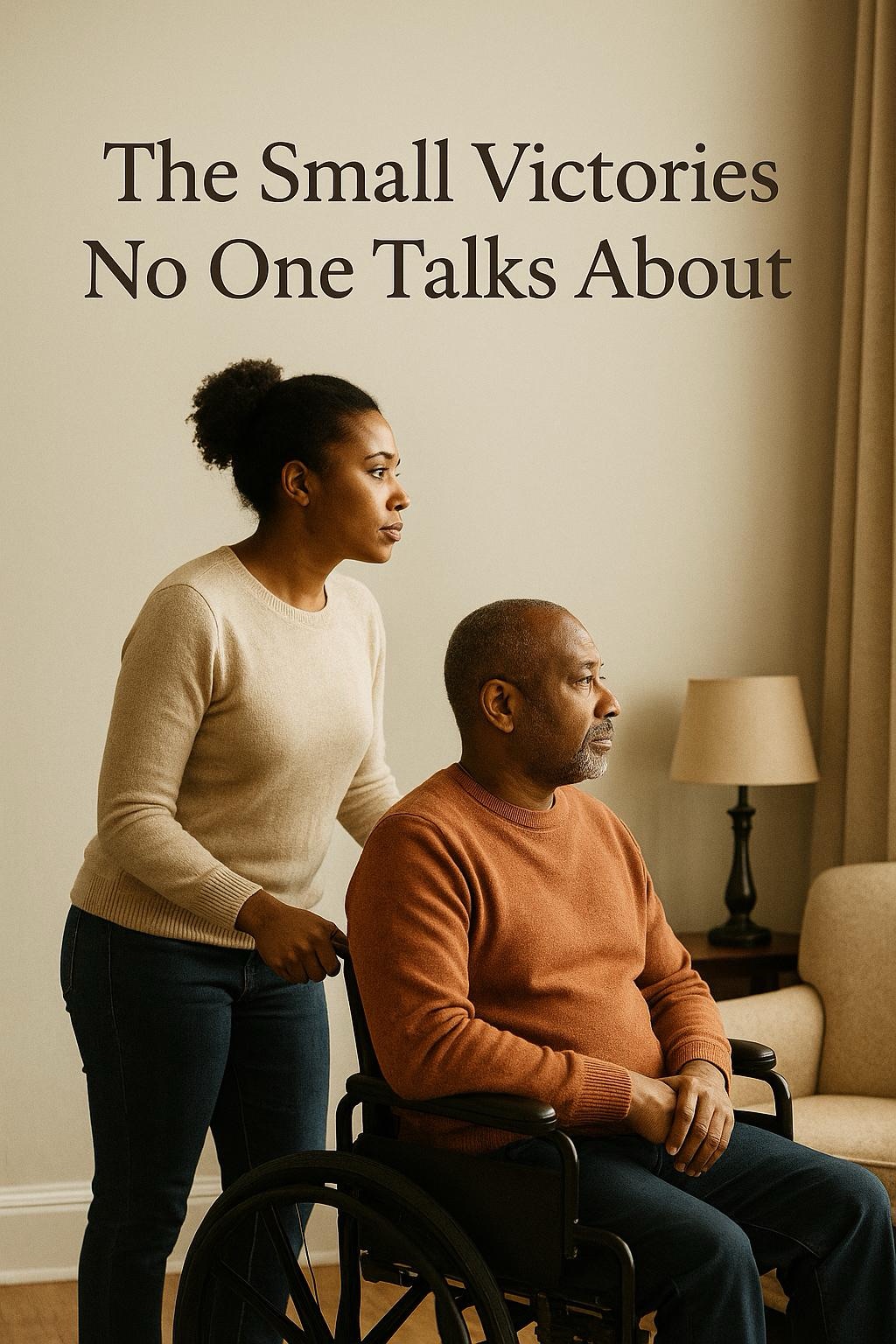
There are several small victories that no one talks about, but they are monumental to the caregiver because we understand how much time and effort went into achieving them. In my situation, there were many. The first small victory came when he finally said a word that was recognizable. It took a few months before he was able to speak even a handful of words we could decipher. Before that, every sound came out as “wawawa,” and we were forced to play the guessing game over and over.
His stroke caused a condition called aphasia. With aphasia, words are hard to pronounce, reading can be difficult, and writing is often nearly impossible. He cannot speak in full sentences, and while aphasia can improve with steady practice and therapy, it never fully goes away. In those early months, he couldn’t spell anything— not even simple words like “cat.” That was one of the hardest parts for me as the caregiver because if he couldn’t speak clearly, I needed him to be able to write things down or text me. But he couldn’t do either at first.
I spent many hours working with him using Pre-K and kindergarten flash cards to help him remember names of things, practice saying words, and jog his memory. I handed him his cell phone and watched him struggle to use it in any capacity. This was a man who once understood and used technology every day—an IT wizard. At first, he couldn’t even remember how to turn his phone off or on. It was a monumental day when everything finally connected and he sent me a short text letting me know he wanted some tea. Now he sends texts all the time. Sometimes they have a few spelling or grammatical errors, but never enough to keep me from understanding what he wants or needs.
I encourage any caregiver: never stop trying when your person is struggling with something. The more they do it, the more progress they’ll make—and the easier life becomes for both of you. It takes patience and creativity to keep them engaged in repetitive tasks without making it feel boring or laborious.
Another not-so-small victory was when the depression finally lifted. Depression is an entire story of its own, one I will likely address in my next blog because it is, in my opinion, the single most challenging aspect of the caregiving journey. In his case, the depression medication didn’t seem to work, and it left us confused and frustrated. Thankfully, we had a great neurologist who recognized from the scenarios I described that he actually had Pseudobulbar Affect. It causes a person to react with the “wrong” emotions—laughing during something serious, becoming angry for no clear reason, or crying out of nowhere. It is essentially a neurological disconnect in the brain. This is not the case for everyone, but it was his. Once that issue was addressed, there was a huge turnaround.
The brain goes through so much in the weeks and months after a stroke as it tries to repair itself. Many significant memories may be lost at first. My husband didn’t remember our wedding. He didn’t remember divorcing his ex-wife. He didn’t remember he had a child. He didn’t remember vacations, and he didn’t remember earning his Bachelor’s Degree in Engineering. Thankfully, all of these memories returned—but not all memories come back. For instance, he no longer remembers how to fix a computer, and that skill used to be as natural to him as breathing. Yet he has mastered the iPhone again and now does things on it that even I can’t figure out.
We celebrate the little victories we have and continue to work on the things that remain challenging. This journey has been full of twists and turns, ups and downs, victories and—dare I say it—failures. But the truth is, the victories far outweigh everything else. There will always be challenges because new ones appear out of nowhere, but as caregivers, we can’t let our faces reflect the difficulty. We want them to stay as positive as possible because it is incredibly discouraging to go from independent to dependent almost overnight.
Our job as caregivers is to face the challenges, find creative ways to make things easier, and stay alert for anything that might improve their lives. I have learned so many things that helped both of us on this journey, and I will share those in upcoming stories. If any of this feels familiar to you, please let me know. Feel free to comment or ask questions—I truly welcome it. My hope is that someone out there feels less alone because of this. This is a difficult job, but it is also a labor of love.
Until next time.
This blog contains affiliate links. As an Amazon Associate, I earn from qualifying purchases at no extra cost to you. I only recommend products that support caregiving, comfort, and daily living.
 The Stroke Effect
Leave a comment